Cooling Is Critical Power: The Thermal Half of Data Center Reliability
Every kilowatt of electricity that enters a server leaves it as heat. Protect 100 kW of IT load with a UPS and you have also committed to removing 100 kW of heat, around the clock, with the same reliability. Data center cooling belongs in the critical power design from the first drawing. Sites that bolt it on later learn that a hot room takes servers down as surely as a failed inverter.
Heat is a reliability problem wearing a comfort mask.
Why comfort air conditioning falls short
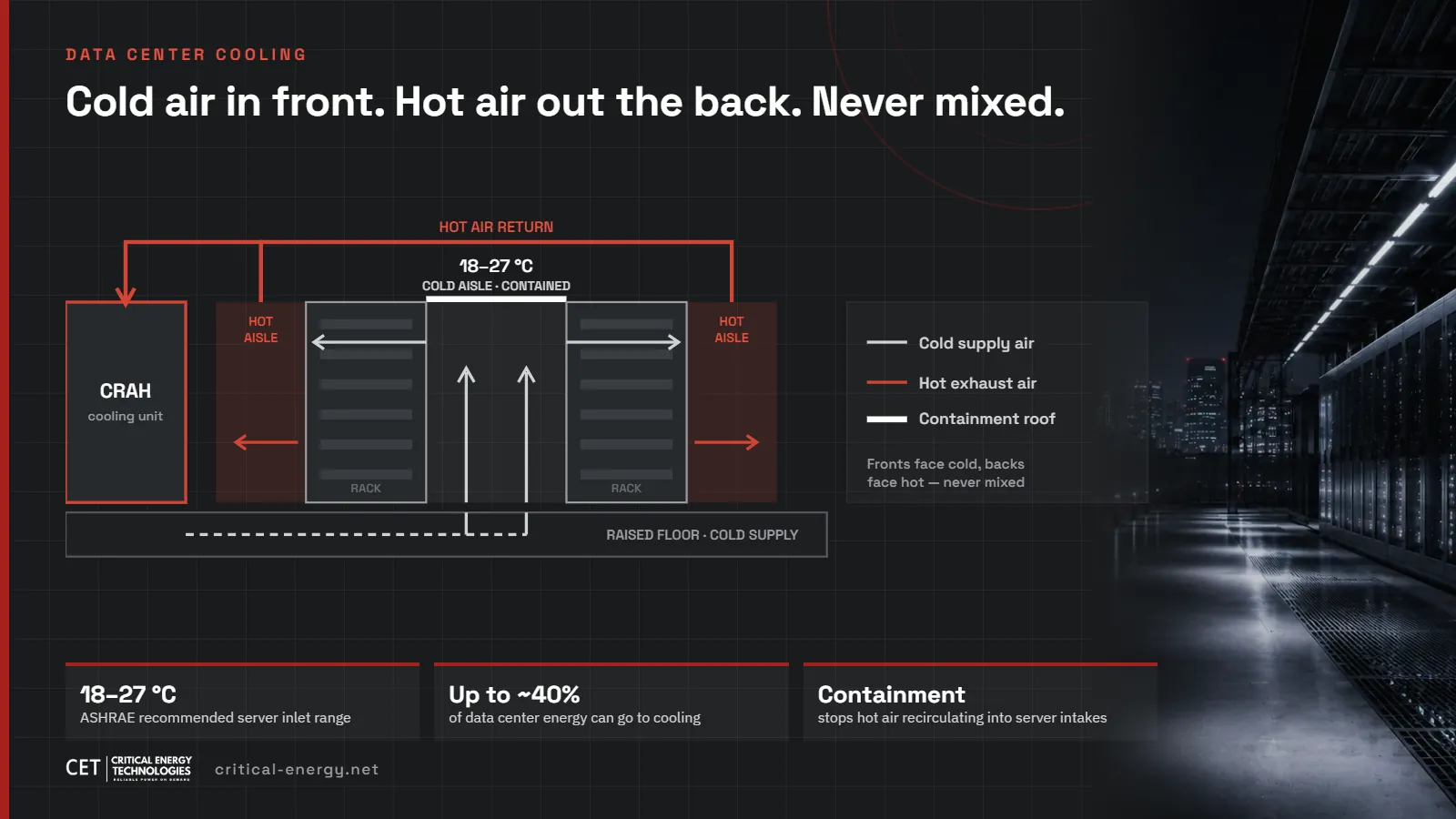
Office split units are built for people: intermittent duty, seasonal use, and a large share of their capacity spent removing moisture from the air. A server room needs the reverse. It runs around the clock all year, its heat is almost entirely sensible, and the equipment wants stable temperature at the server inlet. ASHRAE’s recommended inlet range for IT equipment is 18 to 27 °C.
Precision units are built for that profile. CRAC units carry their own compressors; CRAH units use chilled water from a central plant. Both run with a sensible heat ratio above 0.9, move far more air per kilowatt than comfort units, and come with humidity control, alarms and network monitoring.
| Feature | Comfort split AC | Precision CRAC / CRAH |
|---|---|---|
| Duty | Intermittent, seasonal | Continuous, all year |
| Sensible heat ratio | About 0.65 to 0.75 | 0.9 and above |
| Humidity control | Incidental | Controlled |
| Monitoring and alarms | Rare | Built in, SNMP or Modbus |
| Redundancy | Usually a single unit | N+1 by design |
Fix the airflow before buying equipment
The cheapest cooling gains come from managing air. Arrange racks in hot and cold aisles. Fit blanking panels in every empty rack unit. Seal cable cut-outs in raised floors. Contain the cold or hot aisle so exhaust air cannot loop back into server inlets. Good containment lets you raise supply setpoints and slow the fans, which saves energy you can see on the bill and lowers your PUE without adding a single machine.
For scale, the Uptime Institute’s 2024 global survey put the average data center PUE at 1.56. Small server rooms cooled by comfort split units commonly run far higher, which means a large part of the electricity bill goes to fighting heat that better airflow would have prevented.
Give cooling the same redundancy as power
Designers specify N+1 or 2N for the UPS and then hang the entire thermal load on one air conditioner. Cooling needs the same arithmetic: N+1 units, sequenced so that losing any one leaves enough capacity for the full load. It needs the same visibility too. Put temperature and humidity sensors at rack inlets and route the alarms into the platform that watches your UPS, so a failed compressor reaches an engineer as fast as a failed inverter.
Plan for the first minutes of a power cut as well. The UPS keeps the servers running while the generator starts, but cooling usually runs on generator power only, so the room heats up during the transfer. In dense rooms, fans and pumps on UPS power, or thermal storage, carry the room through that gap. Keep the battery room cool too: a VRLA string loses roughly half its life for every 10 °C of sustained heat above 25 °C, as we explained in our article on UPS battery life.
Designing for Jordan’s climate
Summer peaks in Amman sit in the mid-thirties, and sites in the Jordan Valley and Aqaba run hotter still. Outdoor condensers need derating for those peaks, clear space to reject heat, and filtration that copes with dust. The same climate helps in winter: cool months make free cooling and economiser modes worth engineering into the design from the start.
Critical Energy Technologies designs data center power and cooling as one system: UPS, distribution, precision cooling, containment and monitoring, serviced under a single maintenance plan. See our data center solutions, and if your server room still depends on a wall-mounted split unit, send us the room size and IT load for a cooling assessment.
Data center power in Jordan
Data center power and UPS systems we supply in Jordan
Critical Energy Technologies (CET) designs and supplies data center power across Jordan: online UPS from 1 kVA to 6.4 MVA from Riello UPS (Italy), Legrand UPS (France) and APC by Schneider Electric, batteries from EnerSys and Saft, plus ATS, STS, PDUs, precision cooling, containment and monitoring for server rooms and data halls.
CET brings more than 10 years of hands-on experience in critical and emergency power supply to every project, from the first load survey to commissioning and maintenance. Call +962 77 564 7788, email info@critical-energy.net, or send us your load list for a sized quotation.
 Italy
 France
 Schneider Electric
 China
 USA
 France
Comments are closed