Battery Monitoring Systems: Finding the Weak Block Before It Finds You
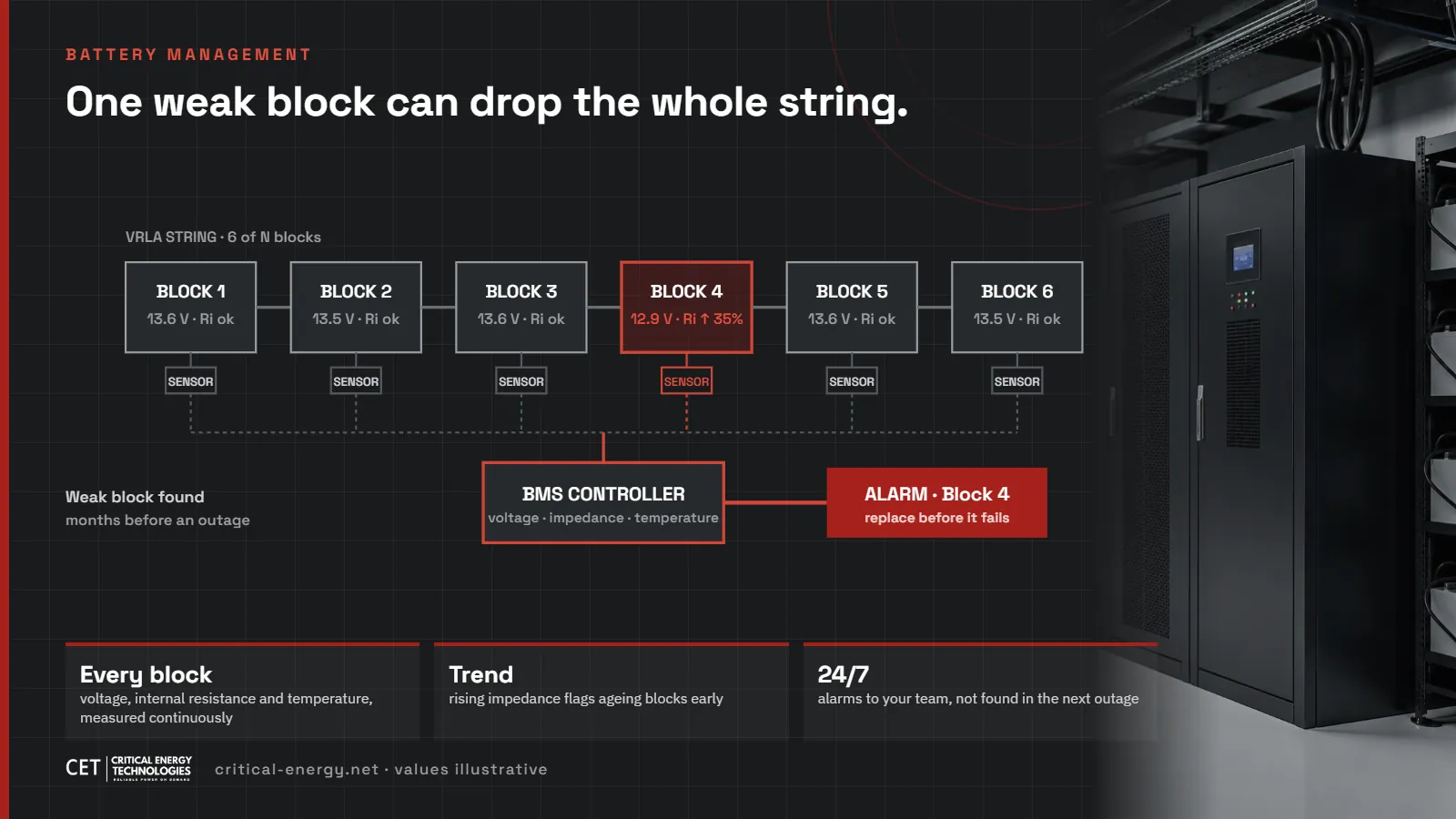
UPS batteries work in series. A 480 V string can hold forty 12 V blocks, and the string delivers only what its weakest block allows. When one block’s internal resistance climbs, it limits current for the whole string, heats up under load and drags its neighbours down with it. The UPS display keeps showing a normal battery voltage the whole time. A UPS battery monitoring system is the tool that closes this gap.
A string of forty blocks with one failed block can still show a healthy float voltage.
Why the UPS panel misses it
The UPS measures its battery as one string: total voltage, charge current and the result of its periodic self-test. Those numbers are averages, and averages hide outliers. When one block fails, the charger spreads the difference across the other thirty-nine and the float voltage still looks right. The weak block reveals itself under a real discharge, which means during the outage your batteries exist to cover.
Built-in self-tests help less than most people assume. Many run a short, shallow discharge that a string with one bad block can keep passing for months.
What a battery monitoring system sees
A monitoring system fits a small sensor on each block and reads voltage, internal resistance and temperature continuously; many systems also measure string current and ripple. The value sits in the trend. A block’s internal resistance rises over months before it fails, and a rise of roughly 20 to 30 percent above that block’s own baseline is the usual trigger for investigation. The system flags the drift while you can still plan around it.
Alarms go to the same SNMP, DCIM or building management platform as the rest of your power chain, as we described in our article on UPS SNMP cards. The history turns replacement into planning. You replace the three blocks that are ageing, on a date you choose, instead of the whole string in a hurry on a date the battery chooses.
| Method | How often | What it resolves |
|---|---|---|
| UPS front panel | Continuous | String level only |
| Manual impedance survey | Quarterly (typical) | Each block, four snapshots a year |
| Battery monitoring system | Continuous | Each block, with trends and alarms |
Monitoring system or manual surveys?
The traditional method is an engineer with an impedance tester taking readings block by block, quarterly, as IEEE 1188 recommends for VRLA batteries. It works, and it is part of our own maintenance plans. It also samples the string four times a year, and batteries do not fail on a quarterly timetable.
For strings behind critical loads, and for any VRLA string past its third year, continuous monitoring earns its cost the first time it catches a failing block early. The two methods work together. The monitoring system watches every hour of every day; the engineer verifies the readings, torques the terminals, cleans the posts and runs the discharge test that proves real capacity. Heat speeds up everything described here, which is why battery room temperature belongs on the same dashboard.
Lithium-ion has it built in
Lithium-ion UPS batteries ship with a battery management system as standard, because the chemistry needs cell-level voltage and temperature control to operate safely. For VRLA and nickel-cadmium strings, monitoring is an addition you choose. If you are weighing chemistries for a new project, our comparison of Li-ion, VRLA and NiCd covers the trade-offs.
Critical Energy Technologies designs and retrofits battery monitoring for UPS rooms of every size, connects the alarms to your existing monitoring, and includes impedance and discharge testing in our maintenance plans. If your string is more than three years old and has never had a block-level survey, book one and we will tell you which blocks are ageing faster than the rest.
Batteries in Jordan
UPS and industrial batteries we supply in Jordan
Critical Energy Technologies (CET) supplies batteries for UPS, telecom and DC systems across Jordan from EnerSys (USA), Saft (France), CSB, Ultracell, Ener Rocket, King Long and NPP, in capacities from 5 Ah to 6,000 Ah. That covers VRLA blocks for server rooms and branch UPS, lithium-ion systems for new builds, and nickel-cadmium strings for substations and hot, remote sites. Every battery ships as genuine stock with a traceable production date.
CET brings more than 10 years of hands-on experience in critical and emergency power supply to every project, from the first load survey to commissioning and maintenance. Call +962 77 564 7788, email info@critical-energy.net, or send us your load list for a sized quotation.
 USA
 France
 VRLA
 UK
- Ener RocketVRLA
- King LongVRLA
- NPPVRLA
Comments are closed