UPS and Industrial Batteries in Jordan
The battery decides how long your equipment stays up when the power goes. We supply VRLA, lithium-ion, nickel-cadmium and OPzS batteries from 5 Ah to 6,000 Ah for UPS systems, substations, telecom sites, control panels and solar systems across Jordan.
We also test existing strings and replace them before a weak block drops the load.

Four battery types, four different jobs
Sealed lead-acid
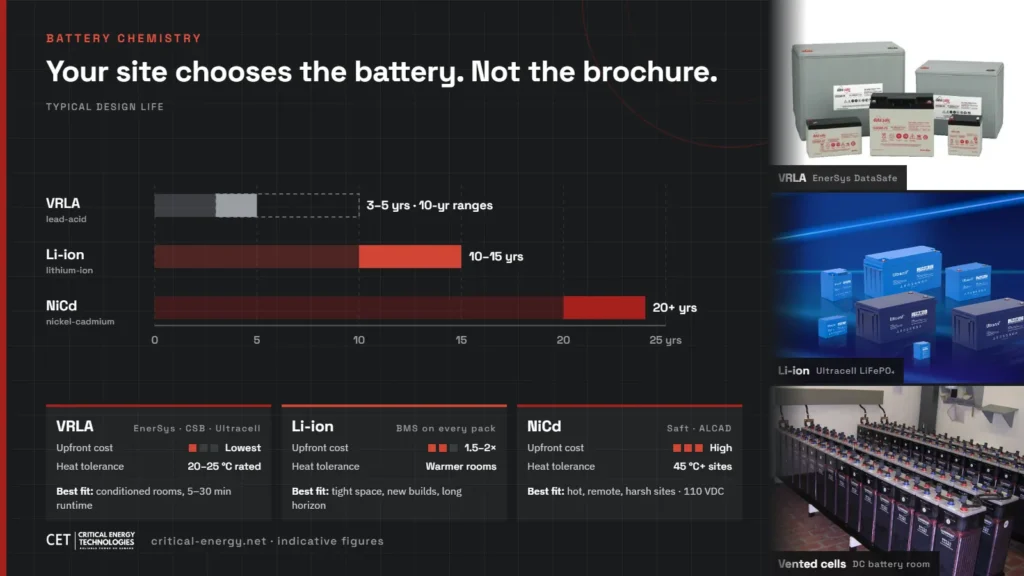
The standard battery in most UPS systems, fire panels and access control. Sealed, no topping up, lowest upfront cost. Heat shortens its life fast.
Lithium iron phosphate
Much lighter and smaller than VRLA for the same runtime, lasts longer and copes better with a warm room. Costs more upfront and needs a UPS that supports it.
Nickel-cadmium
For substations, switchgear and hot or remote sites. Handles deep discharge and extreme temperatures, and fails gradually instead of suddenly.
Vented lead-acid, 2 V cells
Large 2 V cells for telecom exchanges, power plants and DC systems. Needs a ventilated room and topping up every few years.
Service life by type
These are the upper limits for good cells kept at 20 to 25 °C. Temperature and cycling decide where in the range a battery lands, so a hot battery room in an Amman summer can take years off any of them.
| Type | Up to | Where we use it |
|---|---|---|
| Nickel-cadmium | 25 years | Harsh climates, switchgear tripping |
| OPzS flooded | 20 years | Telecom and utility DC |
| Lithium-ion | 15 years | Frequent cycling, compact rooms |
| VRLA / AGM | 12 years | UPS runtime, the standard choice |
Standard 12 V VRLA blocks have a 5-year design life. The 12-year figure applies to long-life VRLA.
What we do with batteries
We work out the runtime against the real load and the battery’s end-of-life capacity, so the bank still meets its target in year five and not only on the day it is installed.
We design battery cabinets and steel racks for the room and the floor loading, supply the chargers and rectifiers that suit the chemistry, and set up monitoring that tracks each block’s voltage, temperature and internal resistance.
On existing sites we run impedance and discharge tests and give you a written report on every string. When a string is due, we replace it with the load protected throughout.

Brands we supply





EnerSys, Saft, Alcad, CSB, Ultracell and NPP, plus matching replacement blocks for most UPS makes, including APC, Eaton, Vertiv, Riello and Legrand UPS. Ranges are listed in the product catalogue. For DC systems, see chargers and rectifiers.
Questions we get asked
How often should UPS batteries be replaced?
Standard 12 V VRLA blocks usually need replacing every 3 to 5 years in Jordan, sooner in a hot room. A yearly impedance test tells you when, before a failed block drops the load.
Can I mix old and new batteries?
No. In a series string the weakest block limits the whole string, and new blocks get overcharged next to old ones. Replace the full string at once.
Is lithium worth the extra cost?
For data centers and hot rooms, often yes. It lasts two to three times as long as a standard VRLA block and takes far less space. The UPS has to support it.
Which battery suits a substation?
NiCd or OPzS on a 110 V or 220 V DC system, charged by an industrial rectifier. NiCd copes best with heat and deep discharge.
Tell us the load and the runtime
Or send the UPS model and a photo of the battery label for a replacement quote. An engineer replies with the right blocks, quantity and price.