Summer Power Reliability in Amman: What Stops First When the Power Cuts?
Every summer in Amman, electrical infrastructure faces a familiar test.
As temperatures rise toward 35–40°C, power demand increases across homes, offices, commercial buildings, hospitals, industrial sites, data centers, and facilities. Air conditioning units, water pumps, servers, elevators, lighting systems, security systems, and production equipment often run at the same time.
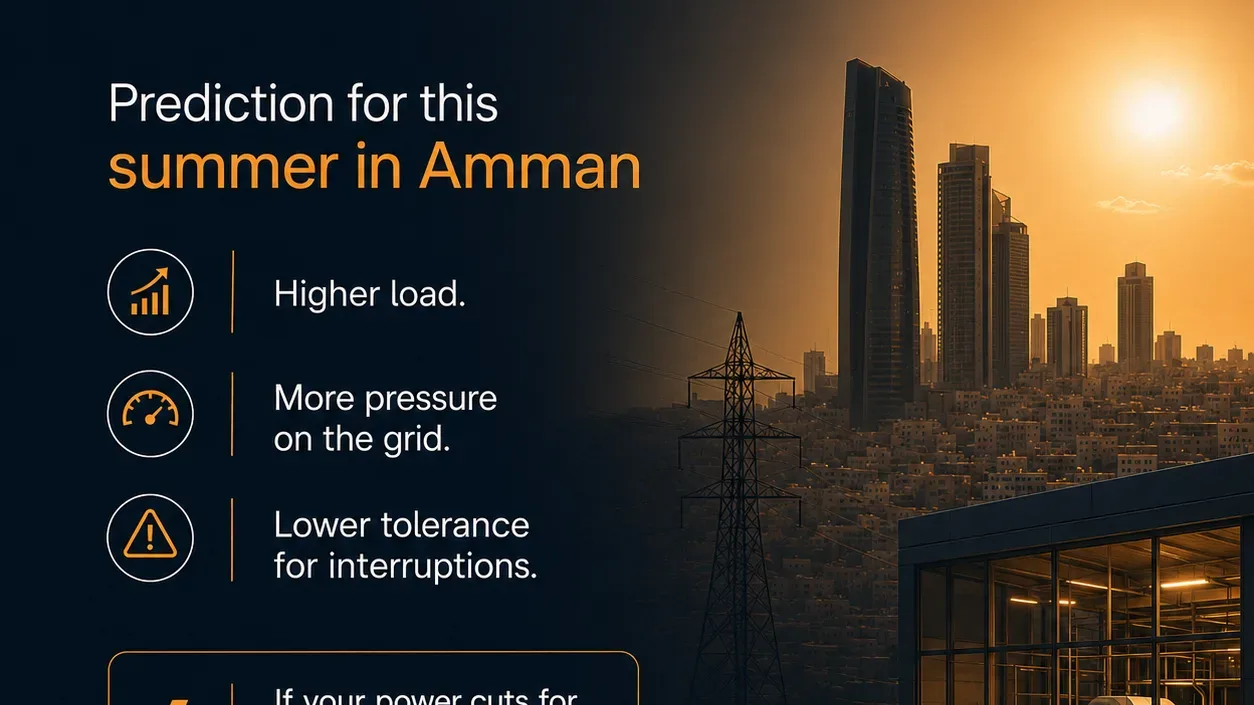
That creates higher load, more pressure on the grid, and much lower tolerance for interruptions.
For many businesses, the real issue is not whether the power goes out for hours. Sometimes, the risk begins with a much shorter interruption.
- If your power cuts for 30 seconds this summer, what actually stops? Not theoretically. In practice.
- Does your server room stay online?
- Do your pumps continue operating?
- Can your payment systems keep running?
- Will your elevators, access control systems, medical equipment, lab equipment, or production lines remain protected?
This is the type of question every facility manager, engineer, IT manager, and business owner should ask before summer demand reaches its peak.
Many businesses only discover their weak points when summer forces the test. A short outage may expose problems in the UPS system, battery autonomy, generator readiness, transfer switch timing, load prioritization, or preventive maintenance plan.
Backup power is not one device. It is a system.
A reliable power continuity setup may include UPS systems for instant response, batteries for short-term continuity, generators for long-term supply, and proper monitoring to make sure the system performs when needed.
The goal is not simply to install equipment. The goal is to understand which loads are critical, how long they need to remain online, and what happens if they stop.
At Critical Energy Technologies, we help businesses in Jordan and the region assess their critical loads, design backup power systems, and prepare their infrastructure for real operating conditions.
Summer will test every system.
The question is whether your business is ready before the interruption happens.
Frequently asked questions
As temperatures climb toward 35–40°C, air conditioning, water pumps, servers, elevators and production equipment all run at once. That raises load, puts more pressure on the grid, and leaves far less tolerance for interruptions.
It does not take hours. A 30-second interruption is enough to drop a server room, stop pumps, halt payment systems or interrupt a production line. The length of the cut matters less than which loads are unprotected when it happens.
No. Backup power is a system, not a single device: UPS systems cover the instant response, batteries carry short-term continuity, generators supply long-term power, and monitoring confirms the whole chain performs when called on. A generator alone leaves a gap between the outage and the moment it takes load.
Battery autonomy, generator readiness, transfer switch timing, load prioritisation and the preventive maintenance plan. A short outage tends to expose whichever of these was neglected.
Related reading: The four operation modes of an online UPS and The High Cost of Cheap Power.
No responses yet