UPS, ATS and Generator: Engineering the Chain That Survives a Blackout
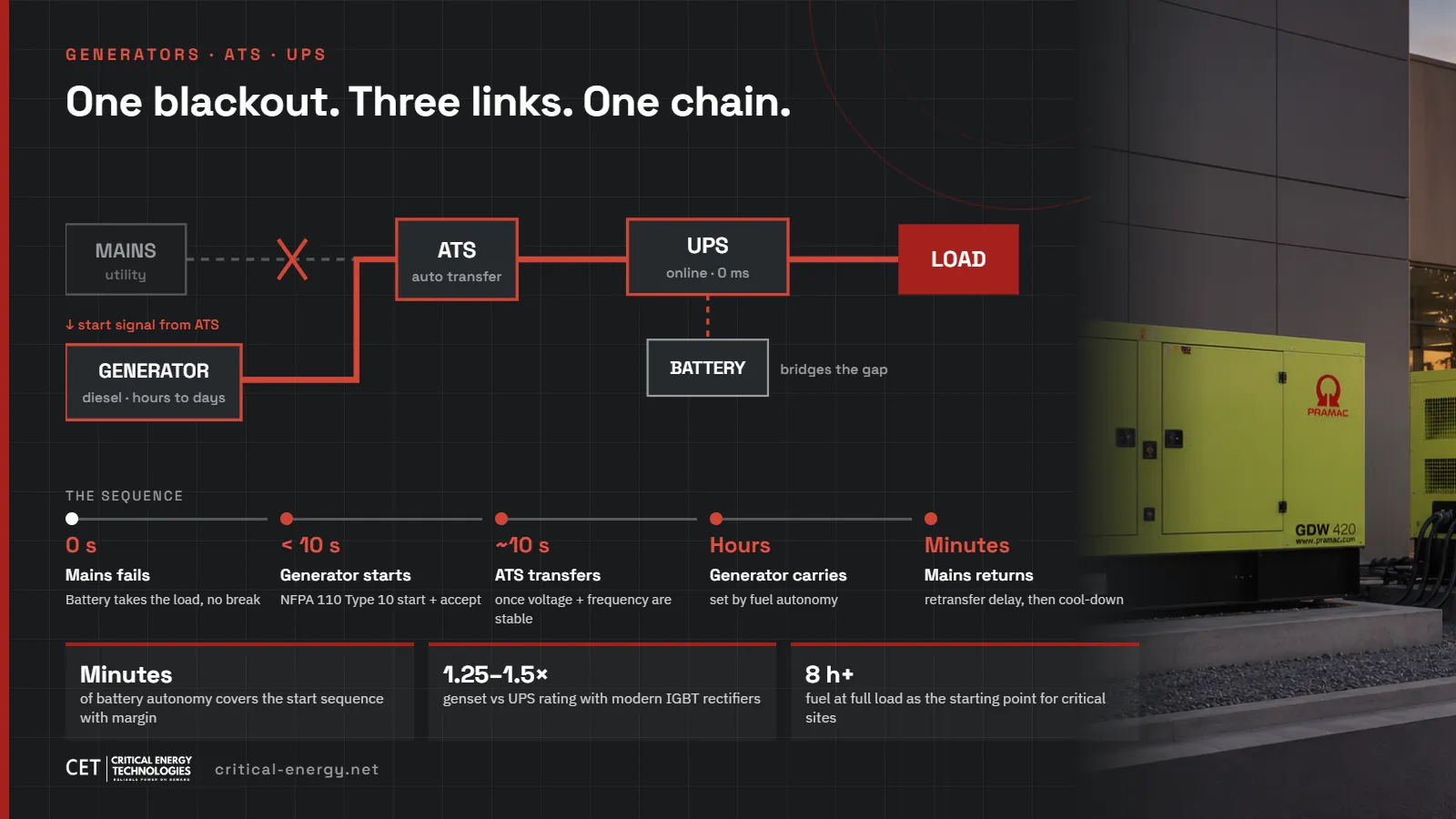
A blackout is a sequence of events. Mains fails. The batteries take the load. A transfer switch starts the generator. The generator stabilises and accepts the load. Mains returns and everything reverses. Each step uses different equipment with different physics, and the UPS, ATS and generator only protect the site when someone engineers them as one chain.
A blackout is a sequence of events, and every link in the chain gets tested in the first ten seconds.
The UPS buys time
When the grid drops, the UPS inverter keeps feeding the load from the battery with no interruption. In this chain its job is to bridge the gap until generator power arrives. NFPA 110 sets 10 seconds as the start-and-accept target for Type 10 emergency systems, and a healthy standby generator meets it. Add margin for a failed first crank and for the ATS to confirm stable voltage, and a few minutes of battery autonomy covers the sequence with room to spare.
That is why generator-backed sites can often run smaller battery strings than sites without one. Battery health still decides the outcome. The first link works once per outage, and a weak string that collapses at second eight drops the load before the generator arrives.
The ATS decides
The automatic transfer switch watches mains voltage and frequency. When they move outside limits for longer than a set delay, the ATS starts the generator, waits for stable output, then transfers the load. When mains returns, it waits out a retransfer delay to confirm the grid is stable, moves the load back, and lets the generator run unloaded for a cool-down period before it stops.
Those timers need tuning to the site. Set the start delay too short and every brief dip starts the generator for nothing. Set it too long and the batteries carry the load longer than they were sized for. We set them during commissioning against the real behaviour of the local supply.
| Link | What it covers | Typical duration |
|---|---|---|
| UPS | From mains failure to generator acceptance | Seconds to minutes |
| ATS | Detection, start signal, transfer and retransfer | Seconds to transfer, minutes to retransfer |
| Generator | The rest of the outage | Hours to days, set by fuel |
The generator carries the hours
Generator sizing is its own discipline. Step loads, motor starting, altitude and temperature derating, and the UPS rectifier all shape the rating. Older six-pulse UPS rectifiers distorted the generator voltage and needed a set of two or more times the UPS rating. Modern IGBT rectifiers with low input harmonics and near-unity input power factor allow a closer match, commonly around 1.25 to 1.5 times the UPS rating. A soft-start ramp on the rectifier stops the UPS from hitting the generator with its full load in one step.
Fuel autonomy completes the picture. For critical sites we start from at least eight hours at full load and adjust to the outage history and refuelling access of the site. Add fuel quality management and a monthly test run under load, because a generator that only runs during outages meets its problems during outages.
What goes wrong with a shopping-list approach
Buy the three pieces separately and the problems are predictable: a generator that hunts because the UPS input disturbs its governor, an ATS that transfers before the generator has stabilised, or batteries sized for 30 minutes protecting a site whose generator starts in ten seconds, which is money spent in the wrong link. Engineering the chain as one system puts the budget where the risk sits. For events and temporary sites, our rental power fleet covers generators and temporary UPS.
Critical Energy Technologies designs, installs and maintains the full chain: Pramac and Generac generators, ATS panels, and UPS from 1 kVA upward, commissioned as one system with one point of accountability. Explore our critical power solutions or send us your load list for a complete design.
Generators in Jordan
Diesel generators we supply and maintain in Jordan
Critical Energy Technologies (CET) is an authorized partner of Generac (USA) and Pramac (Italy) in Jordan. We supply generator sets from 5 kVA to 3,400 kVA, engineered to your load and built on Perkins, Volvo Penta, MTU, Scania and Baudouin engines, with ATS panels, fuel systems and acoustic canopies. We pair them with UPS systems from Riello UPS, Legrand UPS and APC so the whole chain comes from one engineering team.
CET brings more than 10 years of hands-on experience in critical and emergency power supply to every project, from the first load survey to commissioning and maintenance. Call +962 77 564 7788, email info@critical-energy.net, or send us your load list for a sized quotation.
 USA · Authorized partner
 Italy · Authorized partner
- PerkinsEngines
- Volvo PentaEngines
- MTUEngines
- ScaniaEngines
- BaudouinEngines
Comments are closed