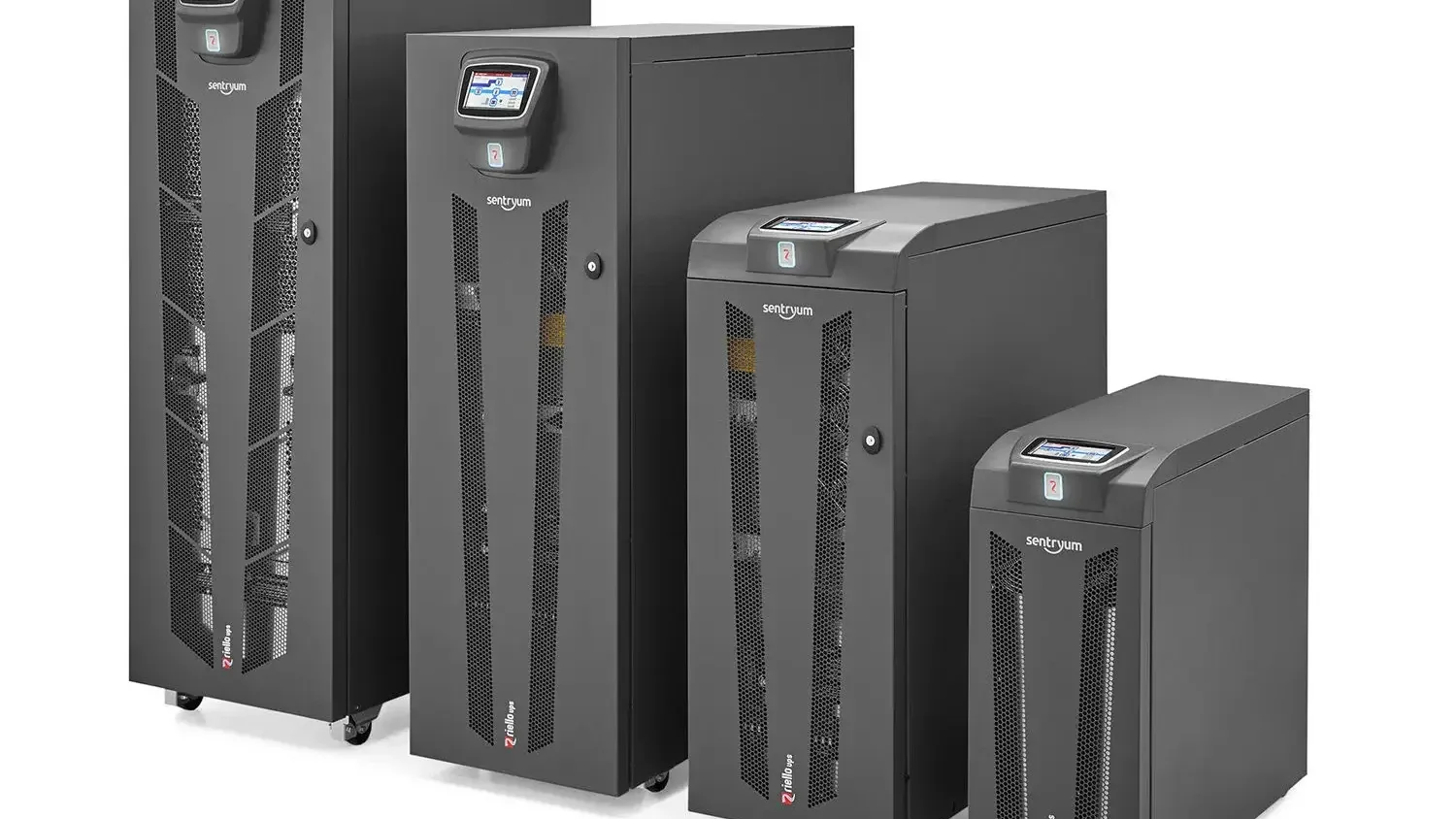
Why do you need a UPS?
The honest answer is not “because the power goes out.” It is because of what happens in the twenty milliseconds before you notice.
Critical Energy Technologies · 6 min read · Updated July 2026
Ask most people why a facility needs a UPS and you get the same answer: for when the power cuts. That answer is not wrong, but it describes the smallest part of the job. Long outages are visible, and they are the ones you plan for. The events that actually kill equipment are the ones nobody sees.
The twenty-millisecond problem
The ITIC curve (formerly CBEMA) defines the voltage envelope that IT equipment is expected to ride through without malfunctioning. Follow the zero-volt line on that curve and you find the number that matters: a typical IT power supply keeps operating for roughly 20 milliseconds after the supply drops to zero. Past that, it stops.
Jordan runs on 50 Hz. At 50 Hz, one cycle lasts exactly 20 milliseconds. A single missed cycle on the incoming supply sits precisely on the boundary of what your servers, PLCs and medical equipment can survive. You will never see it. Your staff will never report it. The breaker will not trip. The equipment simply reboots, corrupts a write, or drops a batch, and someone spends the afternoon working out why.
This is the gap a UPS exists to fill. Not the four-hour outage. The single cycle.
What the grid actually does to your load
Four disturbances account for most of the damage:
- Spikes and transients. Short, violent overvoltages from switching events, faults or lightning. They degrade power supplies and insulation gradually, so the failure arrives months after the cause.
- Voltage dips (sags). The most common power quality event by a wide margin. A large motor starting nearby, or a fault clearing on the network, pulls the voltage down for a few cycles. Sensitive loads drop out.
- Fluctuations and frequency drift. Sustained deviation outside tolerance stresses power supplies and confuses equipment that is watching frequency to stay synchronised.
- Complete failure. The obvious one, and the one every generator is bought to solve.
A generator solves the fourth. It does nothing about the first three, and it is not fast enough for any of them.
Why a generator is not an answer on its own
A standby generator needs to detect the loss, crank, reach speed, stabilise and accept load. On a healthy set that sequence takes somewhere between ten and thirty seconds. Compare that with the twenty milliseconds your load can tolerate and the arithmetic is uncomfortable: your equipment will be down for the entire time the generator is starting.
The UPS covers that gap. The battery carries the load from the instant of failure until the generator is stable, then hands over. A generator without a UPS in front of it protects the building; it does not protect the load. This is the single most common design mistake we correct on site, and the sequencing of the two systems is where most of the engineering actually lives.
The part nobody wants to hear
A UPS is not a box you install and forget. The Uptime Institute’s 2026 outage analysis found that power remains the leading cause of impactful outages, and that failures involving UPS systems, transfer switches and generators dominate that category. More than half of respondents put the cost of their most recent major outage above $100,000; one in five put it above $1 million.
Read that carefully. The equipment installed to prevent downtime is itself a leading cause of it. Not because the technology is unsound, but because batteries age, capacitors dry out, firmware falls behind, and units quietly sit in bypass or ECO mode for months while everyone assumes they are protected.
A UPS you do not test is a UPS you do not have. That is the whole argument for a maintenance contract, and it is why we treat buying on price alone as the expensive option.
So do you actually need one?
Ask a narrower question than “do we need a UPS.” Ask what stops if the supply disappears for one second, and what that costs. If the answer involves a server, a payment terminal, a lab freezer, an operating theatre, a telecom rack, a PLC mid-batch or an access control system on a secure door, you already have your answer. If the answer is the lights and the kettle, you do not need one.
The line is drawn by consequence, not by size. We have installed 3 kVA units that mattered more than 500 kVA ones.
Frequently asked questions
A generator needs roughly ten to thirty seconds to detect the failure, start, stabilise and accept load. Typical IT equipment tolerates about 20 milliseconds without power. The UPS carries the load across that gap and hands over once the generator is stable. A generator alone protects the building, not the load.
Spikes and transients, voltage dips, and frequency or voltage fluctuations. These are far more frequent than complete outages and cause damage that shows up months later as premature equipment failure. A complete blackout is only one of the four disturbances a UPS is there to absorb.
The ITIC curve puts the zero-voltage ride-through of typical IT equipment at around 20 milliseconds. On Jordan’s 50 Hz supply, one cycle is exactly 20 milliseconds, so a single missed cycle sits on the edge of what your load can tolerate.
Yes. Batteries age, capacitors and fans wear, and firmware falls behind. Uptime Institute data consistently shows UPS, transfer switch and generator failures dominating power-related outages. An untested UPS offers assurance rather than protection, which is why discharge testing and a maintenance contract matter as much as the original specification.
Find out what stops
At Critical Energy Technologies we size, install and maintain online UPS systems from 1 kVA to multi-megawatt, and we integrate them with generators so the handover works when it is tested rather than when it is needed. Our clients include the Central Bank of Jordan, the Royal Hashemite Court, the Ministry of Health and As-Samra Wastewater Treatment Plant.
If you cannot say what stops in your facility during a one-second interruption, that is the assessment to start with. Reach us at info@critical-energy.net.
Related reading: The four operation modes of an online UPS and Summer power reliability in Amman.
No responses yet