Data Center Power and Infrastructure Solutions
Power, cooling, monitoring, and infrastructure support for data centers, server rooms, and IT environments.
CET supplies and integrates modular UPS, ATS, STS, PDU, energy storage, precision cooling, containment, and monitoring, designed around the availability your operation requires.
The Continuity Context
Jordan’s data-center demand is climbing as the Levant builds out cloud, connectivity, and disaster-recovery capacity, with Aqaba emerging as a regional carrier-neutral hub. That growth raises the bar on redundant power, cooling, and monitoring. CET supports operators and facility teams building or upgrading the power and environmental layer that keeps a room online. Heat is the second outage risk after power, and a fault you cannot see is a fault you cannot prevent.
What CET Delivers in the Room
Power Infrastructure
Modular UPS, ATS for automatic source transfer, STS for dual-corded equipment, and PDU distribution to the rack. Designed for concurrent maintainability.
Cooling and Environment
In-row and precision cooling, hot and cold aisle containment, and environmental control matched to rack density and room load.
Monitoring and Management
Power, temperature, and alarm monitoring with DCIM-style visibility, so a developing fault surfaces before it becomes an outage.
Build and Design Support
Layout coordination, equipment selection, clean-agent suppression coordination, and commissioning across the power and environmental scope.
Designing to Tier-Style Availability
CET designs to Tier-style availability guidelines, Tier I through Tier IV, using redundancy and concurrent maintainability appropriate to your operation. Tier definitions are used here as engineering design references. CET does not claim Uptime Institute certification unless independently validated for a specific project.
Case Study: A Zero-Downtime Live Server Migration
As CET’s most complex project to date, the team custom-engineered a mobile data center truck with fully synchronized UPS systems, dual diesel generators, precision cooling, and advanced fault alarms, then transferred highly critical servers for the Central Bank of Jordan from Irbid to the Aqaba Digital Hub without a single second of power loss. Synchronized UPS held stable backup during transfer, dual generators gave redundant support, precision cooling protected the servers thermally, and fault alarms monitored every critical risk point.
AI Has Changed the Power Question
A data hall built for 8 to 12 kW racks was designed for a workload that no longer exists at the top end. Average rack density across the industry has climbed sharply, and a single NVIDIA GB200 NVL72 rack draws roughly 120 to 130 kW on its own. Air cooling runs out of physics somewhere around 30 to 40 kW per rack, which is why direct-to-chip liquid cooling has moved from exotic to expected for AI workloads. None of that is a CET claim; it is the direction the market has taken. What it means for us is simpler and more concrete: when the load per rack multiplies, so does everything upstream of it. Bigger UPS blocks, higher fault currents, heavier busway and distribution, more battery, and monitoring that can actually see a developing problem in a rack pulling ten times what the room was designed for. The power chain is where AI density bites first, and it is the layer we own.
What Changes at High Density
Power Path Capacity
UPS blocks, busway and PDU distribution resized for the real rack load, not the original room design.
Fault Current and Protection
Higher currents mean protection coordination and breaker selectivity get re-checked, not inherited.
Battery and Autonomy
More load means more battery for the same runtime. Autonomy gets recalculated, not assumed.
Thermal Coordination
Precision cooling and containment matched to rack density, and coordinated with liquid-cooling loops where they are used.
Modular and Containerized Data Centers
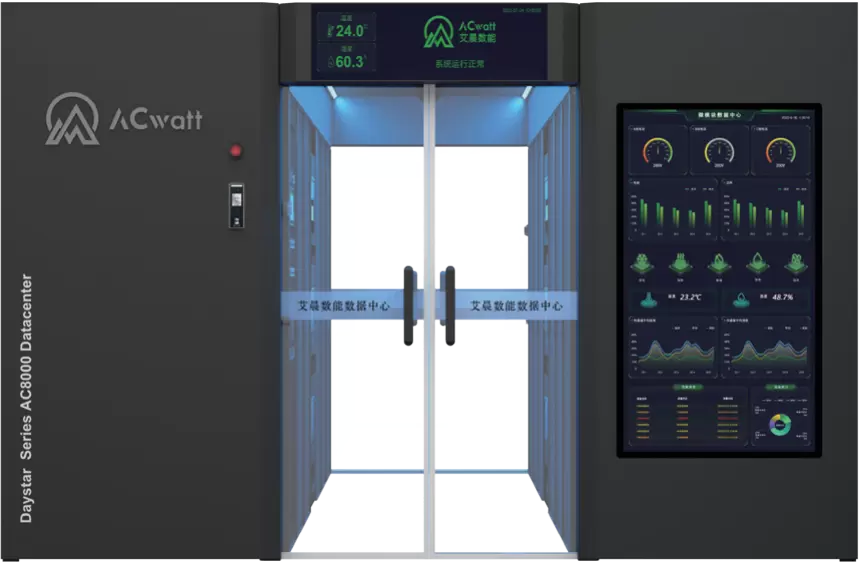
Not every data centre needs to be a building. A modular or containerized deployment puts the power, cooling and IT infrastructure into a pre-engineered enclosure that can be commissioned off-site, delivered, and brought online quickly. It suits edge sites, disaster-recovery capacity, capacity you need before a building is ready, and migrations where the load cannot drop. CET has already built one: the mobile data centre truck we engineered for the Central Bank of Jordan carried synchronized UPS systems, dual diesel generators, precision cooling and fault alarms, and moved live servers from Irbid to Aqaba without a second of power loss. That is a modular data centre in the hardest possible test case, one that had to drive down a motorway while running.
Energy Storage and the Grid
Battery systems in a data hall are no longer only a bridge to the generator. Larger storage blocks let a site ride through short grid events without starting a generator at all, shave peaks, and hold the load steady while a generator synchronizes. CET sizes and supplies the storage layer alongside the UPS and the DC plant, tests it, and replaces strings before they fail rather than after. Autonomy targets get set against the real load and the real transfer time to the generator, which is the only number that matters when the grid actually drops.
CONTACT INFORMATION
Let’s talk about building something dependable
Reach out to CET for backup power systems, UPS solutions, generator support, rental equipment, data center infrastructure, maintenance, procurement, or technical consultation.